
Blooming
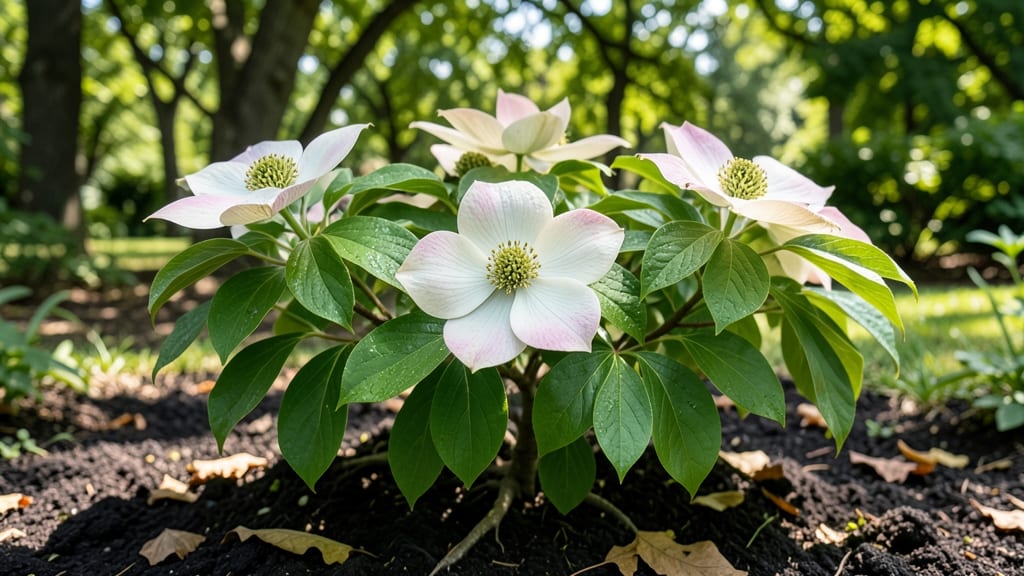
A dogwood bloom looks like clusters of delicate white or pink four-petaled flowers surrounded by large, showy bracts in red, pink, or white. These papery petal-like structures create a striking visual contrast, often resembling a single large flower when viewed from a distance.
A dogwood's true flowers are small and often overlooked, but the showy bracts steal the show with their vibrant colors and textured appearance. 🌸 These modified leaves frame the actual flowers, creating the illusion of a single large bloom.
Different species offer unique color variations—some feature pure white bracts, while others display deep red or soft pink hues that fade beautifully into spring.
The blooms typically appear in late spring, with Cornus florida (the most common species) flowering around April to May in most regions. This timing helps distinguish them from similar flowers like magnolias, which bloom earlier, or azaleas, which often appear later.
The arching stems and glossy leaves add to their distinctive look, making them a standout feature in any landscape.
💡 In This Article
- Identifying Dogwood Flower Structures and Color Variations
- How to Spot Dogwood Blooms vs Similar Spring Flowers
Identifying dogwood flower structures and color variations
The dogwood's true flowers are actually quite modest—each cluster contains 4-6 tiny, white or pale pink blossoms that measure just 0.5 inches (1.25 cm) wide. What makes them visually striking are the showy bracts, which are modified leaves that surround the flowers.
These bracts can measure up to 2 inches (5 cm) across and often resemble petals, creating the illusion of a single large flower.
The color variations are where dogwoods truly shine. Cornus florida, the most common species, typically features white bracts with pink centers, while Cornus kousa often displays deep pink or red bracts that fade to white.
Some cultivars even produce pure white blooms with no pink tint. The bracts have a distinctive papery texture that feels slightly rough to the touch, unlike the smooth petals of many other spring flowers. 🌸
Seasonal timing plays a crucial role in identification. Dogwoods bloom in late April to early May in most temperate regions, which helps distinguish them from earlier bloomers like magnolias or later arrivals such as azaleas.
The blooms appear on arching stems that can reach 12-20 feet (3.5-6 meters) tall, creating a dramatic vertical display. Each cluster contains 6-10 flowers, with the bracts arranged in a circular pattern around the central blossoms.
Regional variations are worth noting. In the southeastern United States, Cornus florida dominates, while Cornus kousa thrives in the Midwest and Pacific Northwest. The latter species often produces larger, more robust blooms with thicker bracts.
Some wild varieties even develop yellow-green bracts, though these are rare. The glossy, elliptical leaves—typically 3-5 inches (7.5-12.5 cm) long—emerge after the flowers, adding another layer of visual interest.
What makes dogwood blooms particularly fascinating is their evolutionary adaptation. The bracts have evolved to attract pollinators by mimicking the appearance of larger, more rewarding flowers. This deception helps the small, inconspicuous true flowers remain hidden while still attracting bees and other pollinators.
The result is a stunning visual display that's both beautiful and functionally brilliant. 🌿
When examining a dogwood bloom up close, you'll notice the bracts have visible veins and a slightly waxy sheen, especially when fresh. The true flowers, meanwhile, have 6 stamens and a 4-lobed stigma, though these details are rarely visible to the naked eye.
This combination of showy bracts and subtle true flowers creates a perfect balance between visual appeal and functional design in nature.