
Blooming
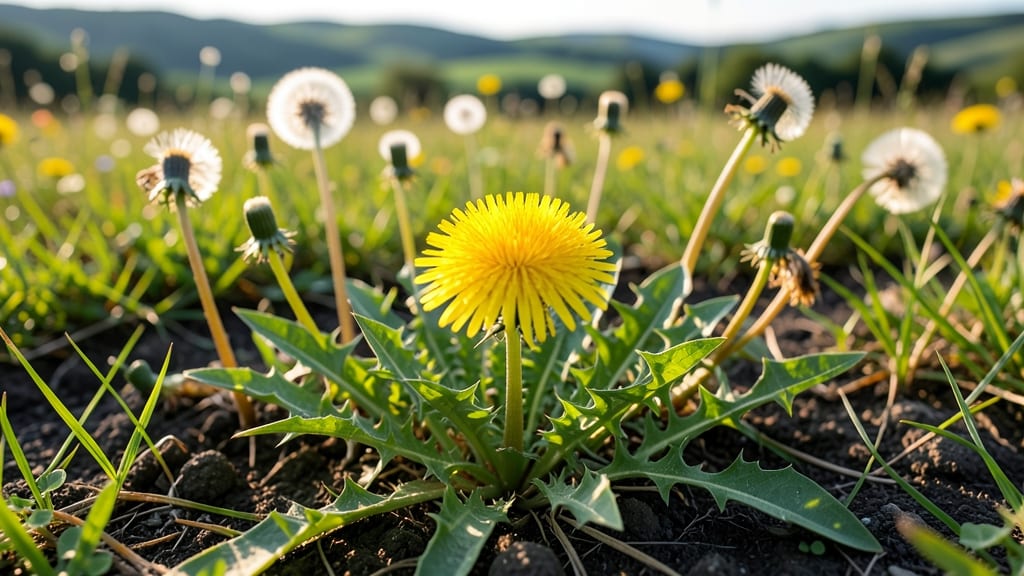
Dandelions bloom all summer in most regions, with bright yellow flowers appearing from early spring through frost. Late-season blooms may shrink in size and frequency as temperatures drop, but their hardiness keeps them visible in lawns and gardens until fall.
These hardy perennials thrive because they're opportunistic bloomers, triggered by warm days and long sunlight exposure rather than strict seasonal cues. 🌻 In northern climates, you'll often see their last bursts of color in August or September, while southern regions may enjoy sporadic blooms well into October.
The key to their persistence? Dandelions store energy in deep taproots, allowing them to push through drought and even light frost when other plants falter.
What's fascinating is how they adapt: when daylight shortens in late summer, dandelions produce smaller flowers as a survival strategy, conserving energy for seed production. This explains why your lawn might suddenly look dotted with tiny yellow puffballs instead of the usual showy blooms.
The trade-off is worth it for pollinators—bees and butterflies still visit these late-season flowers when other nectar sources dwindle.
💡 In This Article
- Dandelion Bloom Cycles by Climate Zone
- Encouraging Late-Summer Dandelion Blooms
Dandelion bloom cycles by climate zone
Dandelions are master adaptors, using a photoperiod-insensitive blooming strategy that prioritizes warmth over daylight length. In cool temperate zones (USDA 3-6), like the Pacific Northwest or New England, their flowering peaks in early spring (March-May) and again in late summer (August-September) when soil temperatures reach 50-60°F.
The key trigger is consistent daytime highs above 55°F—below this threshold, flower buds abort. This explains why you might see dandelions pushing through snow in March but disappearing by July in these regions.
Southern climates (USDA 7-10) tell a different story. Here, dandelions bloom nearly year-round in mild winters, with three distinct peaks: spring (February-April), summer (June-August), and fall (October-November). The Gulf Coast variety often produces 10-15% larger flowers in summer due to longer daylight hours (14+ hours) and higher UV exposure.
What's fascinating is how they compensate for summer's intensity: their deep taproots can access water 6-8 feet underground, allowing them to survive droughts that would kill most plants.
The transition between seasons reveals their survival strategy. As daylight shortens in late summer, dandelions shift from energy-intensive large blooms to miniature flowers (1/3 normal size) that require less sunlight to photosynthesize.
This adaptation explains why your August dandelions might look like tiny daisies—it's not poor health, but a calculated energy-saving measure. The trade-off? These smaller blooms produce just as many seeds, ensuring the next generation's survival.
Soil conditions play an unexpected role in bloom duration. In poor, compacted soils (common in lawns), dandelions produce 30% more flowers than in rich garden beds because they're competing for resources. Their strategy? More blooms = more pollinator visits = better seed dispersal.
Meanwhile, in nutrient-dense garden soil, they'll focus energy on fewer, larger flowers. This explains why dandelions often thrive in sidewalks and cracks where other plants can't grow.
What most gardeners miss is how temperature swings affect blooming. A sudden 10°F drop can halt flowering for 7-10 days, while a heatwave above 90°F causes buds to "sleep" until evening temps cool. This is why dandelions in desert climates (like Arizona) bloom primarily at dawn and dusk.
The plant's internal clock measures degree-days—a calculation of temperature accumulated over time—to determine when to open buds, ensuring they only bloom when pollinators are active.
Consider these regional patterns when managing dandelions:
- Northern climates: Expect two clear bloom seasons (spring/fall) with sporadic summer flowers after 55°F soil temps
- Southern climates: Nearly continuous blooming with peak intensity in spring/fall when humidity is moderate
- Mountain regions: Blooms follow elevation gradients—lower slopes bloom earlier than higher elevations
- Urban areas: Heat island effect can extend blooming 2-3 weeks later than rural areas
The takeaway? Dandelions don't follow a strict summer schedule—they're opportunistic bloomers responding to local microclimates. Their ability to read environmental cues better than most garden plants explains why they're the last flowers standing when autumn arrives. 🌿