
Blooming
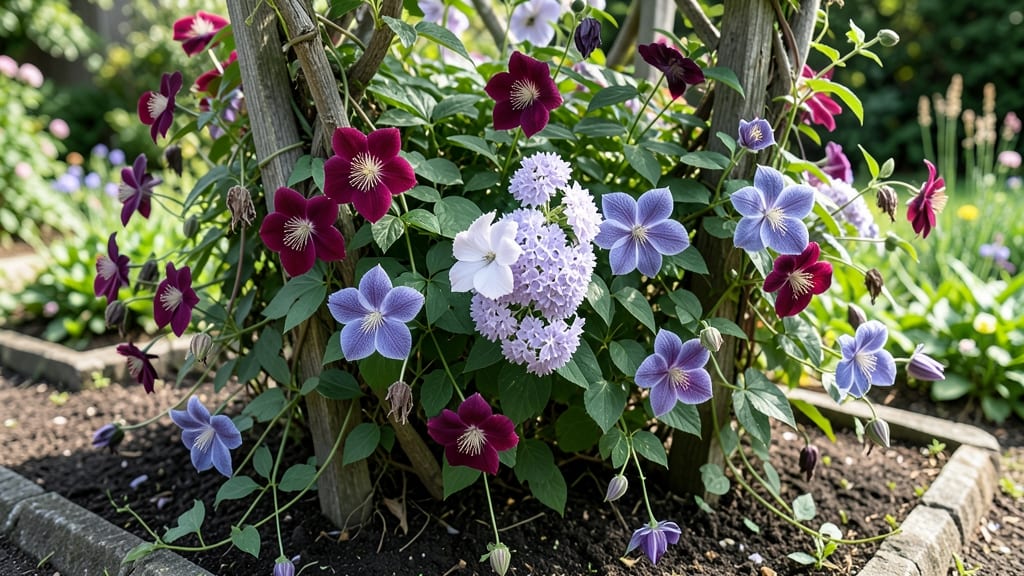
Whether clematis bloom all summer depends entirely on the variety: early-blooming types produce a single flush in spring, while reblooming types can deliver multiple cycles—spring through summer—if pruned correctly at the right time. Varieties like 'Jackmanii' and 'Niobe' often reward gardeners with extended summer color when given proper late-season care.
Clematis flowering habits are like a seasonal dance—some varieties perform just once, while others put on multiple shows if you follow the choreography. 🌸 The key lies in their pruning groups: Group 1 (early bloomers) sets their spring show and then rests, while Groups 2 and 3 (rebloomers) can be coaxed into a second act with strategic summer pruning.
For example, 'Durandal' often rewards patient gardeners with a late-summer encore if deadheaded regularly, while 'The President' thrives in partial shade and keeps blooming through August if pruned back after its first flush. The secret?
Timing your cuts right—too early or too late can leave your clematis staging an empty performance.
What truly separates the showstoppers from the one-hit wonders is sunlight exposure and soil health. Reblooming varieties need at least 6 hours of morning sun to fuel their second growth spurt, while early bloomers can tolerate more shade.
I've found that adding a balanced fertilizer in early summer gives my clematis the energy boost they need for extended blooming—think of it as backstage crew keeping the lights on between acts. The payoff? A garden that stays in full bloom from May through September with minimal extra effort.
💡 In This Article
- How Clematis Flowering Cycles Work
- Best Clematis Varieties for Continuous Summer Blooms
How clematis flowering cycles work
Clematis flowering cycles are governed by their growth habit classification into three groups, each with distinct biological triggers. Group 1 varieties bloom on previous year's growth (woody stems) in early spring, typically from March to May, before the plant's main growth begins.
These early bloomers, like 'Wyoming' or 'Early Sensation', produce a single flush of flowers and then enter dormancy—no amount of pruning will coax them into reblooming.
The mechanism here is tied to temperature sensitivity: cooler winter temperatures stimulate flower buds to form on old wood, which then bloom when daytime temperatures rise above 50°F.
The real summer bloomers belong to Groups 2 and 3, which produce flowers on current season's growth. Group 2 varieties (like 'Jackmanii') bloom on both old and new wood, while Group 3 (such as 'The President') bloom exclusively on new growth.
What makes these types special is their ability to form secondary flower buds after the first flush, triggered by a combination of day length (photoperiodism) and nutrient availability.
When you prune these varieties correctly—typically after their first bloom—you're essentially giving the plant a second chance to produce flowers by encouraging new growth from the base. The science here involves auxin hormones, which regulate cell elongation and flowering in response to pruning cuts.
Timing is everything when it comes to summer blooms. For Group 2 varieties, the magic happens when you prune back by about one-third immediately after the first flush, which typically occurs around June in most climates.
This stimulates the plant to produce new shoots from the base, which will then flower again in late summer. Group 3 varieties need even more aggressive pruning—cutting back to just a few strong stems in early spring—to encourage vigorous new growth that will bloom continuously.
What most gardeners don't realize is that these varieties often produce their best second flush when daytime temperatures remain above 70°F for at least 6-8 weeks after pruning.
The color show continues because these reblooming varieties have evolved to take advantage of summer's longer daylight hours. Their flowering mechanism is tied to the plant's ability to photosynthesize efficiently during these extended days, which provides the energy needed to support multiple flower cycles.
For example, 'Durandal' often produces its second flush in August because it's adapted to take advantage of the warm, sunny conditions typical of late summer. The trade-off?
These varieties require more frequent deadheading to remove spent blooms, which encourages the plant to redirect its energy into producing new flowers rather than seed development.
One fascinating aspect is how regional climate affects these cycles. In cooler northern climates, summer blooms might be shorter-lived due to shorter growing seasons, while in warmer southern regions, some varieties can continue blooming into October if given proper care.
The key is understanding your local last frost date and adjusting your pruning schedule accordingly.
For instance, in Zone 5, you might need to wait until mid-June to prune Group 2 varieties to avoid frost damage to new growth, while in Zone 8, you can prune as early as April and still get summer blooms.
Soil health plays an equally important role in extending the blooming season. Clematis are heavy feeders, and their ability to produce multiple flower cycles depends on consistent nutrient availability. A well-draining soil with a pH between 6.0 and 7.5 provides the ideal environment for root development and nutrient uptake.
I've found that applying a balanced 10-10-10 fertilizer in early spring and again after the first bloom gives my reblooming varieties the energy they need to perform their summer encore. The result? A garden that stays in full bloom from May through September with minimal extra effort.
What truly separates the showstoppers from the one-hit wonders is their ability to adapt to your garden's specific conditions. While some varieties like 'Jackmanii' are more forgiving and will rebloom even with less-than-perfect care, others like 'The President' demand precise timing and conditions to deliver their best performance.
The good news? With the right variety selection and a bit of seasonal attention, you can turn your clematis into a continuous summer star rather than a one-season wonder. 🌿