
Blooming
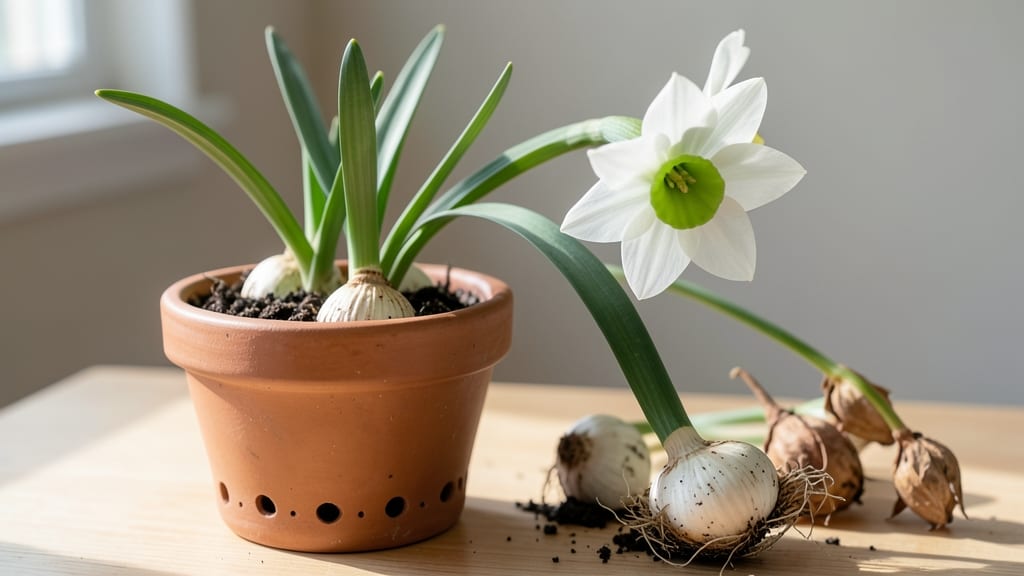
Paperwhites will not bloom again after their first flowering cycle because they are annuals in their natural lifecycle, depleting energy reserves during blooming. Forcing them indoors accelerates this process, leaving no stored energy for regrowth or reblooming.
Paperwhites are annuals in their natural state, meaning they complete their lifecycle—including blooming—in just one season. 🌱 When you force them indoors, their energy is completely expended during that single burst of flowers, leaving nothing left for a second bloom.
Unlike perennials, paperwhites don't store enough nutrients to recover and rebloom, so each bulb has only one chance to shine.
What this means for you is that once those fragrant white blooms fade, your paperwhites have fulfilled their purpose. However, you can still extend their life by repotting the bulb after flowering—this might encourage new foliage growth, though it won't produce more flowers.
The key is understanding their biological limits while making the most of their temporary beauty.
💡 In This Article
- Why Paperwhites Are Annuals and Never Rebloom
- How to Extend Paperwhite Bulb Longevity Beyond First Bloom
Why paperwhites are annuals and never rebloom
Paperwhites (Narcissus papyraceus) are true annuals in their natural Mediterranean habitat, meaning their entire lifecycle—from bulb to bloom to seed—completes in just one growing season. 🌱 The key difference from perennials lies in their bulb structure: paperwhites store minimal nutrients compared to perennials like daffodils.
Their bulbs contain only enough energy to fuel a single, dramatic flowering event before completely depleting their reserves.
The blooming process itself is energy-intensive. Each cluster of fragrant white flowers requires significant metabolic resources to develop, with the bulb diverting up to 70-80% of its stored carbohydrates to support flower production.
Indoor forcing accelerates this depletion—what would normally take months in the wild happens in just 4-6 weeks under artificial light and warmth, leaving the bulb with no energy left for recovery or reblooming.
What most people don't realize is that even after flowering, the bulb's root system remains active for 4-6 weeks as it tries to replenish some energy through photosynthesis. However, the foliage is already weak from the energy drain, and any new growth is purely vegetative—no flowers will emerge.
This is why you might see new leaves after blooming, but never another flower stalk.
In their native coastal dunes, paperwhites rely on winter rains to trigger germination, then bloom in early spring before the hot Mediterranean summers. This one-season lifecycle is an adaptation to their harsh environment—there's no evolutionary advantage to reblooming when the bulb would likely die anyway.
Indoor forcing mimics this wild cycle, just compressed into weeks rather than months.
Here's the biological breakdown: paperwhites lack the thick, layered bulbs of perennials (like tulips) that store multiple seasons' worth of nutrients. Their bulbs are more like modified stems with just enough energy for one spectacular show.
Even if you keep the bulb alive post-bloom, it will never accumulate sufficient reserves to produce another flower stalk—it's a one-and-done biological investment.
The only way to "rebloom" would be to grow from seed, but this takes 2-3 years and produces much smaller, less fragrant flowers. The bulb you started with has fulfilled its genetic purpose after that first bloom cycle.