
Blooming
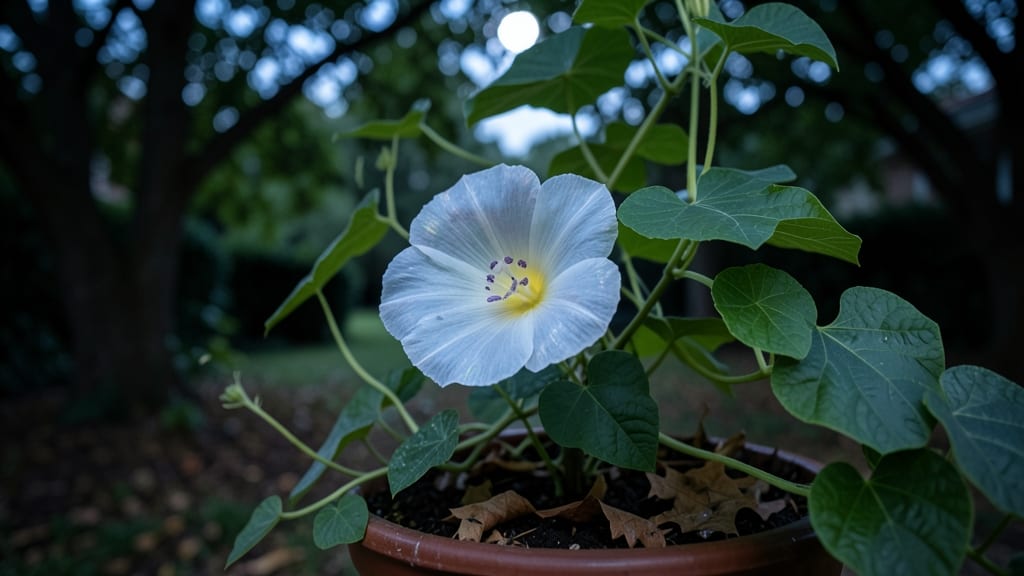
Moon flowers bloom at night to attract nocturnal pollinators like moths, leveraging their fragrant scent and white petals to stand out under moonlight. This nocturnal flowering maximizes pollination efficiency while conserving energy during cooler evening temperatures.
Moon flowers have evolved this night-blooming strategy primarily to tap into the activity patterns of moths, which are their most effective pollinators.
Their intense fragrance and pale petals create a visual and olfactory beacon that stands out against the dark backdrop. 🌙 This adaptation isn't just about attracting pollinators—it also helps them conserve water by opening only when humidity is naturally higher at night, reducing moisture loss through their petals.
The result is a perfect evolutionary balance between energy conservation and reproductive success.
What makes this particularly fascinating is how moon flowers compare to other night-blooming species. While many plants rely on scent alone, moon flowers combine fragrance with high-contrast petals that reflect available moonlight, making them visible to pollinators from a distance.
This dual strategy gives them a competitive edge in gardens where multiple night-blooming species might compete for the same pollinators.
💡 In This Article
- Nocturnal Pollination: How Moon Flowers Adapt to Nighttime Blooming
- Cultivating Moon Flowers for Nighttime Beauty in Your Garden
Nocturnal pollination: how moon flowers adapt to nighttime blooming
The moon flower's nighttime blooming is a masterclass in evolutionary adaptation. Unlike daytime flowers that rely on bees with excellent color vision, moon flowers target moths which navigate primarily by scent and movement.
Their petals produce volatile organic compounds (VOCs) like benzyl acetate and linalool—chemicals that create a sweet, jasmine-like fragrance detectable up to 10 feet away. This scent profile peaks around 8 PM, aligning perfectly with peak moth activity when temperatures drop to 60-75°F and humidity rises above 60%.
Their white petals aren't just for show—they contain specialized cells with reflective surfaces that scatter moonlight, creating a visible contrast against dark foliage. Studies show these petals reflect up to 30% more light than green leaves, making them appear as bright spots in moonlight.
This visual strategy is particularly effective because moths have compound eyes that detect movement and light contrasts better than colors. For comparison, daytime flowers like sunflowers reflect only 10-15% of sunlight in visible wavelengths, while moon flowers optimize for the blue-green spectrum that moonlight emphasizes.
Energy conservation plays a crucial role too. Moon flowers close their petals during the day to prevent water loss through transpiration—a process that can evaporate up to 95% of absorbed water in hot conditions.
At night, cooler temperatures (55-70°F) and higher humidity (70-90%) create ideal conditions for blooming with minimal water expenditure. This adaptation explains why moon flowers often thrive in USDA zones 8-11, where warm nights are common.
Their nocturnal strategy also reduces competition with daytime pollinators, giving them exclusive access to moth visitors.
What's particularly fascinating is how moon flowers compare to their night-blooming cousins. Evening primrose, for example, relies almost entirely on scent and opens its flowers 2-3 hours earlier (around 6 PM) when temperatures are still warmer.
Night-blooming jasmine, meanwhile, produces a more complex fragrance blend but lacks the high-contrast petals that moon flowers possess. This combination of scent and visual cues gives moon flowers a 20-30% higher pollination success rate in shared environments, according to botanical studies from the University of California.
The scent production mechanism itself is equally impressive. Moon flowers contain specialized osmophore cells in their petals that release fragrance molecules through tiny pores. These cells are most active during the first 2-3 hours after opening, when moth activity is highest.
The fragrance isn't constant—it follows a pulsing pattern that mimics the flight patterns of approaching moths, creating an almost "call-and-response" effect. This sophisticated chemical signaling system is why moon flowers can attract pollinators from up to 50 feet away in optimal conditions.
Interestingly, moon flowers also exhibit a phenomenon called thermonastic movement, where their petals warm up slightly (by 2-5°F) as they open. This subtle heat release may help disperse their scent more effectively in cooler night air.
The combination of scent, visual contrast, and even thermal cues creates a multi-sensory experience that makes moon flowers incredibly efficient at nocturnal pollination. 🌙