
Blooming
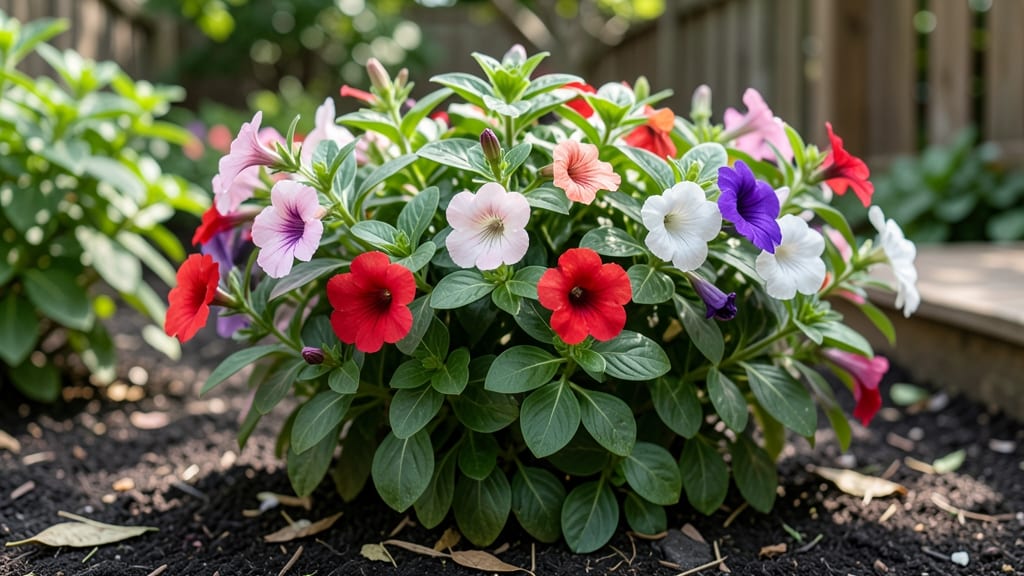
Impatiens do bloom all summer long, but their vibrant displays depend on staying within their ideal temperature range of 60°F to 75°F. When temperatures climb above 85°F or drop below 50°F, these delicate flowers struggle to maintain blooms, often wilting or entering dormancy. Popular varieties like Impatiens walleriana (busy Lizzie) need extra care during heatwaves to keep flowering.
Impatiens thrive in consistent warmth, but their blooming cycle can stall when stressed by extreme heat or cold. 🌡️ The key to summer-long flowers lies in creating microclimates—using shade cloths or planting near taller perennials to block afternoon sun.
I've seen Impatiens hawkeri (New Guinea impatiens) handle slightly warmer conditions better than traditional busy Lizzies, thanks to their thicker leaves and deeper roots. For container gardens, switching to self-watering pots with mulch helps maintain moisture levels critical for blooming.
Even with perfect conditions, impatiens need regular feeding—every 2-3 weeks with a balanced liquid fertilizer—to sustain their nonstop blooming. 🌸 The trade-off? They're sensitive to drought and overwatering, so checking soil moisture daily during heatwaves makes all the difference.
Varieties like 'Super Elfin' or 'Fusion' often outperform others in marginal conditions, proving that not all impatiens are created equal when it comes to summer endurance.
💡 In This Article
- Heat and Temperature Limits for Impatiens Flower Longevity
- Extending Impatiens Blooms Through Strategic Care
Heat and temperature limits for impatiens flower longevity
Impatiens respond to heat stress through a cascade of physiological changes that directly impact their blooming. When temperatures exceed 85°F, their stomata (pores on leaves) close to conserve moisture, which reduces photosynthesis and energy production for flower development.
This stomatal closure also triggers ethylene gas buildup—a plant stress hormone that accelerates leaf yellowing and bud drop. The roots, already sensitive to dehydration, begin to suffocate in dry soil, further cutting off nutrient supply to the flowers. 🔥
The difference between Impatiens walleriana (busy Lizzie) and Impatiens hawkeri (New Guinea impatiens) lies in their native environments. Busy Lizzies, adapted to shadier, cooler understory conditions, wilt dramatically above 80°F and often stop blooming entirely.
In contrast, New Guinea varieties, native to tropical highlands, tolerate 90°F better due to their thicker, waxy leaves that reduce water loss. Their deeper root systems also access moisture more efficiently during heatwaves.
Cold stress works differently—below 50°F, impatiens enter a survival mode where metabolic processes slow dramatically. The flowers fail to open properly, and existing blooms drop prematurely. This chilling injury occurs because impatiens lack cold-hardiness proteins found in perennials like pansies.
The damage is often irreversible, as their tender stems can't recover from prolonged exposure to 40°F or lower. 🌡️
What's fascinating is how humidity interacts with these temperature limits. In dry heat (low humidity), impatiens suffer more from transpiration stress than in humid heat.
For example, in Arizona's desert climate (95°F with 15% humidity), busy Lizzies may survive but produce sparse blooms, while in Florida's 90°F with 70% humidity, they thrive with proper shade. This explains why coastal gardens often support summer impatiens better than inland ones.
Even within the ideal 60-75°F range, nighttime temperatures matter. If nights drop below 60°F, the flowers won't open fully the next day—a phenomenon called "temperature shock." This is why gardeners in northern climates sometimes see impatiens bloom heavily in daytime but fail to open their flowers at cooler evenings.
The plant's circadian rhythm gets disrupted, leading to what looks like a sudden bloom failure. ✨
For gardeners pushing the limits, consider that Impatiens balsamina (garden balsam) handles heat better than traditional impatiens, withstanding 95°F when given afternoon shade. Their secret? A more robust stem structure and higher tolerance for ethylene stress.
This variety proves that not all impatiens follow the same temperature rules—something worth remembering when selecting summer-long performers.