
Blooming
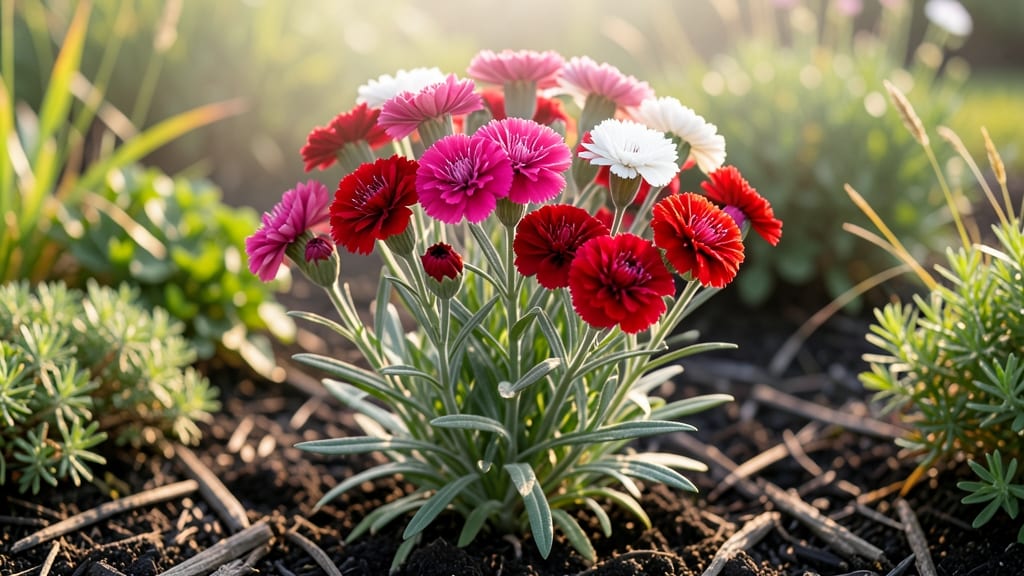
Carnations don't bloom all summer continuously because intense heat and dry conditions cause flowering to pause. They prefer cooler spring and fall temperatures, but with proper care—like afternoon shade and regular watering—you can encourage blooms into early or late summer in temperate regions.
Carnations are sensitive to summer's heat waves, which disrupt their natural growth cycle.
When temperatures rise above 85°F, the plants often enter a stress response, dropping buds and slowing down photosynthesis. 🔥 The key to keeping them blooming is mimicking their ideal conditions—think of it like giving them a break from the midday sun with shade cloth or partial shade from nearby trees.
Even heat-tolerant varieties will benefit from consistent moisture, as drought stress forces them into dormancy faster than high temperatures alone.
What many gardeners don't realize is that carnations actually store energy in their roots during cooler seasons. This reserve helps them bounce back when you provide the right conditions during summer's peak.
I've seen carnations in containers revive completely after just two weeks of afternoon shade and daily watering during heatwaves. The secret is consistency—skipping watering or shade for even a few days can set back their recovery by weeks.
💡 In This Article
- Heat Stress and Carnations: Why Summer Blooms Fade
- Extending Carnation Blooms in Hot Climates: Late-Season Gardening Tips
Heat stress and carnations: why summer blooms fade
Carnations respond to heat stress through a complex physiological process that begins with disrupted photosynthesis. When temperatures exceed 85°F, the plant's stomata (tiny pores on leaves) close to conserve moisture, which immediately reduces carbon dioxide intake.
This slows down the production of glucose—the energy source for flower development. 🔥 The plant essentially shifts into survival mode, redirecting resources to root growth instead of blooming.
Studies show that carnations exposed to continuous temperatures above 90°F can experience up to a 70% reduction in flower production within just 10 days.
The soil plays a critical role in this process. High temperatures bake the topsoil, creating a hardpan that blocks water absorption. Carnations have shallow root systems, typically reaching only 6-12 inches deep, so they're particularly vulnerable to drought stress.
When soil moisture drops below 30% saturation, the plant's vascular system struggles to transport water and nutrients, leading to bud drop. The combination of heat and dry soil triggers ethylene production—a plant hormone that accelerates aging and causes flowers to wilt prematurely.
Humidity levels further complicate matters. Carnations thrive in environments with 40-60% relative humidity. In dry summer conditions, humidity often drops below 30%**, causing the plant's leaves to lose moisture through transpiration at an unsustainable rate.
This creates a vicious cycle: the plant loses water faster than it can absorb it, leading to wilting and eventually dormancy. The visual signs are unmistakable—leaves curl inward, flowers fail to open, and stems become brittle to the touch.
Interestingly, carnations have evolved different heat tolerance levels based on their origin. European varieties, bred for cooler climates, often struggle in summer heat, while some Mediterranean types (like Dianthus barbatus) can handle temperatures up to 95°F with proper care.
The key difference lies in their waxy leaf coatings—heat-tolerant varieties have thicker cuticles that reduce water loss. This natural adaptation explains why some gardeners report sporadic blooms even in summer, while others see complete cessation.
What most gardeners overlook is how carnations manage their energy reserves. These plants store carbohydrates in their roots during cooler seasons, creating a buffer that can sustain them through short heatwaves. However, this reserve depletes quickly when stressed by both heat and drought simultaneously.
The depletion shows up as yellowing leaves at the base of the plant—an early warning sign that the carnation is shifting resources away from flowering to root maintenance. 💫
Understanding this physiological response helps explain why carnations often produce fewer blooms in summer, even with regular watering. The heat itself isn't the sole culprit—it's the combination of high temperatures, low humidity, and poor soil moisture that creates an environment where flowering becomes energetically unsustainable for the plant.
This is why shade solutions and mulching become essential strategies for summer care.