
Blooming
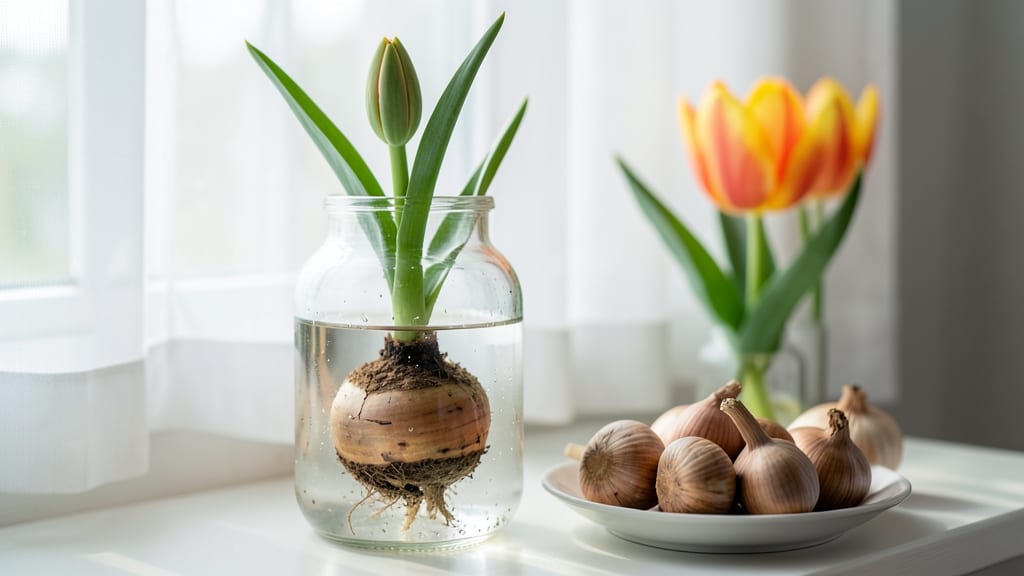
Tulip bulbs forced in water will not bloom again indoors because their stored energy is completely used up during flowering. However, replanting them in soil outdoors can still produce future blooms if given proper sunlight, drainage, and dormancy conditions.
Forcing tulips indoors is like giving them a one-time performance—they'll put on their best show, but the effort drains their energy reserves. 🌱 The bulbs rely on carbohydrates stored during their natural growth cycle, and forcing them indoors uses up these reserves faster than they can replenish.
When you replant them, you're essentially giving them a second chance to rebuild their strength for next season's blooms.
Here's the key difference: bulbs forced indoors have already expended their energy on blooming, while those planted outdoors gradually build reserves through photosynthesis and seasonal cycles.
Proper replanting—with well-draining soil, consistent moisture, and a full growing season—can restore their ability to produce flowers again, though it may take 1-2 years for them to regain full strength.
💡 In This Article
- Why Forced Tulip Bulbs Rarely Rebloom Indoors
- How to Replant Forced Tulip Bulbs for Future Blooms
Why forced tulip bulbs rarely rebloom indoors
When you force tulip bulbs indoors, they undergo an accelerated blooming process that mimics their natural spring cycle—but at a cost. Tulips store energy in their bulb as starches and sugars, which convert to fuel for growth and flowering.
A single indoor forcing cycle can consume 80-90% of these stored reserves. 🌸 This is why most forced bulbs won't rebloom indoors: their energy bank is nearly empty after producing stems, leaves, and flowers.
Unlike outdoor-grown tulips that gradually rebuild reserves over months, indoor forcing demands all their resources in just 4-6 weeks.
The biological mechanism involves two key phases: geotropic growth (stem elongation) and phototropic flowering. Indoors, artificial light sources often lack the 12-16 hours of daylight tulips need for optimal photosynthesis, forcing them to rely entirely on pre-stored energy.
The bulb's basal plate—the area where roots would normally form—also weakens during forcing, making it harder to regenerate roots for future growth. Even with perfect care, the bulb's metabolic system is too exhausted to support another flowering cycle without external energy sources.
Temperature plays a critical role in this energy depletion. Forcing typically requires 60-65°F environments, which speeds up cellular respiration—the process that converts stored energy into usable fuel.
At these temperatures, bulbs burn through their reserves 3-4 times faster than they would in outdoor dormancy. 🌡️ Compare this to outdoor bulbs, which experience natural temperature fluctuations (including winter dormancy at 40-50°F
This seasonal rhythm allows outdoor bulbs to gradually replenish their reserves through photosynthesis and root growth. One common misconception is that bulbs forced in water (like the classic vase method) somehow preserve energy better than soil-grown bulbs. In reality, both methods deplete reserves equally—water-forcing just removes the soil's natural insulation and moisture regulation. The bulb's root system, which normally anchors it and absorbs nutrients, remains underdeveloped during forcing. Without roots, the bulb can't access additional water or minerals, leaving it completely dependent on its initial energy stores. Here's what happens at the cellular level: The bulb's vascular system prioritizes flower production over root development during forcing. Specialized cells called parenchyma break down starch granules into sugars, which are transported to growing tissues. By the time the bloom fades, these parenchyma cells are 90% depleted, leaving little capacity for future growth. 🔬 This is why even well-cared-for forced bulbs often produce only foliage (leaves) in subsequent years—they lack the energy to form flowers until their reserves are partially restored. The only exception occurs when bulbs are replanted immediately after forcing, given optimal outdoor conditions. In this case, they can begin photosynthesizing through their leaves, gradually rebuilding starch reserves over 6-8 weeks of summer growth. However, this requires perfect timing—bulbs must be planted before their foliage yellows completely, as this signals the end of the growing season and triggers dormancy. Without this window, the bulb's energy system remains permanently compromised.