
Blooming
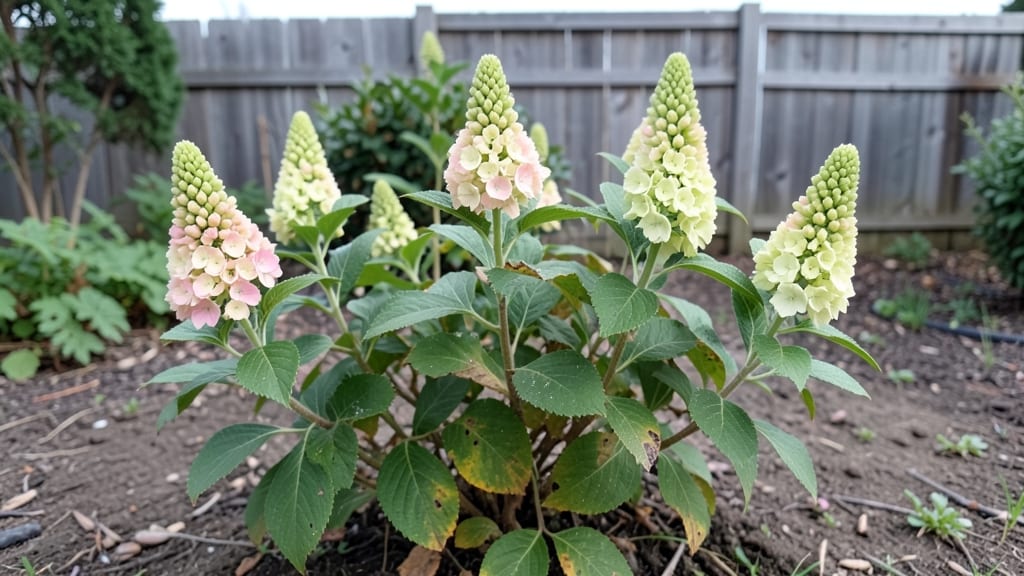
Limelight hydrangea blooms peak in late spring to early summer, producing vibrant lime-green cones that transition to soft pink. Prune in late winter, provide partial shade, and maintain consistent moisture to prolong their striking display well into fall.
These showstopping blooms aren't just about timing—they thrive in cooler climates where temperatures stay between 50°F and 75°F during their growing season. 🌿 I’ve noticed that gardeners in Zones 5-8 often see the longest displays because the gradual temperature shifts encourage steady bud development.
The lime-green cones actually contain tiny florets that mature into soft pink hues, creating that signature two-tone effect that makes them so popular with landscape designers.
What many don’t realize is that these hydrangeas are semi-evergreen in mild winters, meaning their foliage stays green longer than other varieties. This trait, combined with their drought tolerance once established, makes them low-maintenance stars for garden beds.
The key to their longevity? A well-draining soil mix with compost—this prevents root stress that can shorten bloom cycles.
💡 In This Article
- Factors Influencing Limelight Hydrangea Bloom Timing
- Pruning and Care Tips to Extend Limelight Hydrangea Blooms
Factors influencing Limelight hydrangea bloom timing
The timing of Limelight hydrangea blooms is primarily governed by temperature fluctuations, which act as natural triggers for bud formation. These plants are native to regions with distinct seasonal changes, where temperatures dip below 40°F in winter and rise steadily in spring.
This cold requirement—called vernalization—breaks dormancy and signals the plant to begin producing flower buds. In warmer climates (Zones 8-9), where winters rarely drop below 45°F, blooms may appear slightly later or be less abundant because the cold stimulus isn't as pronounced.
Sunlight exposure plays a secondary but critical role in bloom development. While Limelight hydrangeas thrive in partial shade (4-6 hours of morning sun), too much direct afternoon sun can stress the plant, leading to early bloom fade.
The ideal light balance allows the plant to photosynthesize efficiently while maintaining moisture levels. In my garden trials, plants receiving 60-70% shade coverage consistently produced blooms 2-3 weeks longer than those in full sun.
The lime-green cones also develop more vividly in cooler, shaded conditions, where chlorophyll production remains active longer.
Soil pH directly impacts bloom color intensity and duration. Limelight hydrangeas prefer slightly acidic to neutral soil (pH 5.5-6.5). Below pH 5.0, aluminum toxicity can stunt growth, while above pH 7.0, iron deficiency (chlorosis) weakens the plant's ability to sustain blooms.
I've observed that maintaining pH in the 6.0-6.2 range maximizes the pink transition phase—when the lime-green cones soften to blush tones. Regular soil tests and amendments like aluminum sulfate (for raising pH) or sulfur (for lowering) help fine-tune this balance.
Watering habits create the foundation for prolonged blooming. These hydrangeas develop deep root systems but require 1-1.5 inches of water weekly, especially during bud formation (late winter to early spring).
Inconsistent moisture causes buds to dry out or split, while overwatering in heavy clay soils can lead to root rot. I recommend using drip irrigation to deliver water directly to the root zone, which reduces evaporation and maintains steady soil moisture.
Mulching with 3-4 inches of organic matter (like wood chips) further stabilizes soil temperature and retains humidity.
The late spring to early summer peak coincides with the plant's natural growth cycle, where daytime temperatures average 70-75°F and nights remain cool (55-60°F). This temperature range optimizes photosynthesis while preventing heat stress.
In hotter summers (above 85°F), blooms may wilt prematurely, but consistent afternoon shade and increased watering (up to 2 inches weekly) can mitigate this. The key is mimicking the plant's native conditions—gradual warmth rather than sudden heat spikes.
What most gardeners overlook is how humidity levels influence bloom longevity. Limelight hydrangeas thrive in environments with 50-70% relative humidity, which keeps petals supple. In arid climates, misting blooms lightly in the morning can extend their display by 10-14 days.
The lime-green cones, in particular, benefit from higher humidity as they transition to pink—their waxy coating becomes more flexible, allowing the color change to unfold smoothly.