
Blooming
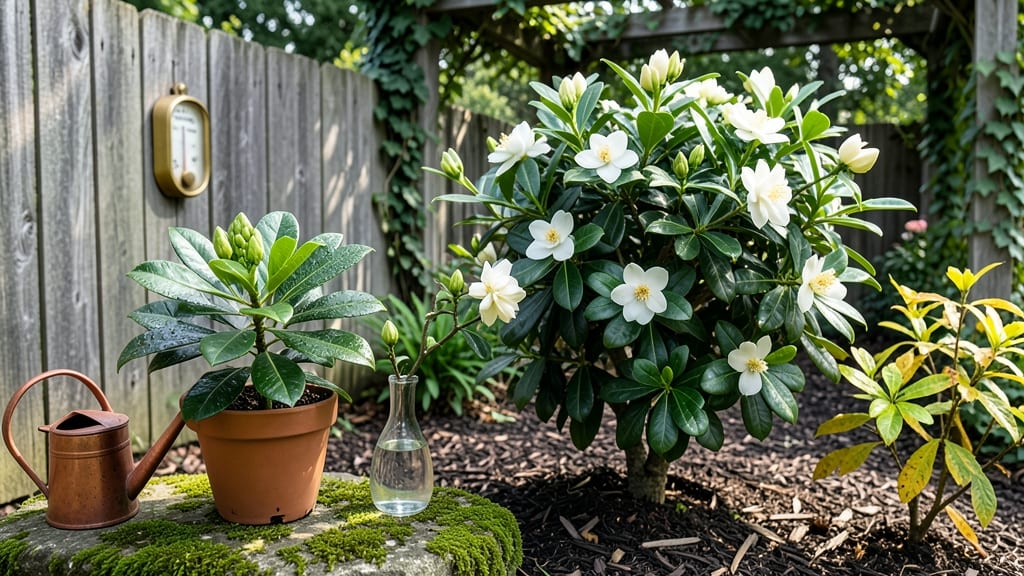
Gardenias do not bloom all year; most varieties produce flowers seasonally, typically spring through summer, with some late-fall blooms. Regional climates and specific cultivars influence bloom duration and frequency, requiring strategic care for extended flowering periods.
Gardenias are tropical plants at heart, and their blooming habits reflect that. 🌸 In warmer climates like Florida or Hawaii (USDA zones 10-11), gardenias may bloom nearly year-round, but even there, they often take a brief pause during the hottest months.
In cooler regions (zones 7-9), blooms are strictly seasonal, with a peak in late spring and early summer. The key factors are temperature consistency and daylight exposure—gardenias need warmth to trigger blooming but can't handle extreme heat, which is why they sometimes rest during summer's peak.
What's fascinating is how different varieties play into this. Some, like the 'Radicans' or 'Kleim's Hardy,' are bred to handle cooler temperatures and may produce occasional blooms in fall, while tropical varieties like 'Veitchii' focus their energy on summer displays.
The good news? With the right care—like strategic pruning after blooms fade and consistent moisture—you can coax some varieties to rebloom later in the season.
💡 In This Article
- Gardenia Bloom Cycles by Climate and Variety
- Tips to Extend Gardenia Flowering Season
Gardenia bloom cycles by climate and variety
Gardenias rely on a delicate balance of environmental cues to trigger blooming, primarily temperature consistency and daylight exposure. These tropical plants originate from Southeast Asia, where they experience warm, humid climates year-round.
In their native habitat, gardenias bloom continuously when temperatures stay between 65-80°F—anything hotter or colder disrupts their natural rhythm.
For example, in Florida's USDA zone 10, gardenias may bloom nearly year-round, while in California's zone 9, they take a 2-3 month summer break when temperatures exceed 90°F.
The length of daylight also plays a critical role. Gardenias are short-day plants, meaning they respond to decreasing daylight hours (typically 12 hours of light or less) as a signal to bloom.
This explains why spring and early summer—when days are lengthening but not yet at their peak—are prime blooming seasons.
In contrast, tropical varieties like 'Veitchii' may produce fewer blooms in summer's long daylight, while hardier types like 'Kleim's Hardy' adapt better to 10-12 hour daylight windows, allowing for occasional fall blooms in cooler climates.
Humidity is another key factor. Gardenias thrive in 60-80% relative humidity, and dry air—common in indoor settings or arid regions—can cause buds to drop before opening.
This is why gardenias grown in USDA zones 7-8 often struggle to bloom reliably; they require extra care like misting or humidity trays to mimic their natural environment. The scent of gardenia blooms, which contains benzaldehyde and linalool compounds, also peaks during optimal humidity, creating that signature tropical fragrance.
Variety-specific traits further complicate the blooming cycle. Tropical gardenias, like 'Fortuniana,' focus their energy on one major bloom cycle per year, typically spring to early summer.
In contrast, hybrid varieties such as 'Radicans' may produce two smaller bloom cycles—one in spring and another in late summer—if given proper care. The trade-off? Tropical varieties often have larger, more fragrant blooms, while hardier types may sacrifice bloom size for resilience in cooler climates.
What most gardeners overlook is how root temperature affects blooming. Gardenias need warm roots (70-75°F) to thrive, which is why container-grown plants in cooler zones often bloom less reliably. Using insulated pots or root zone heating can extend the blooming season by 3-4 weeks in marginal climates.
This is particularly useful for gardeners in USDA zone 8, where winter dormancy can last 2-3 months.
Finally, consider the age of the plant. Young gardenias (under 3 years old) often focus energy on foliage growth rather than blooming. It can take 2-4 years for a gardenia to establish enough root mass to support regular flowering.
This explains why newly planted gardenias may produce only 1-2 blooms per season before maturing into consistent producers.