
Blooming
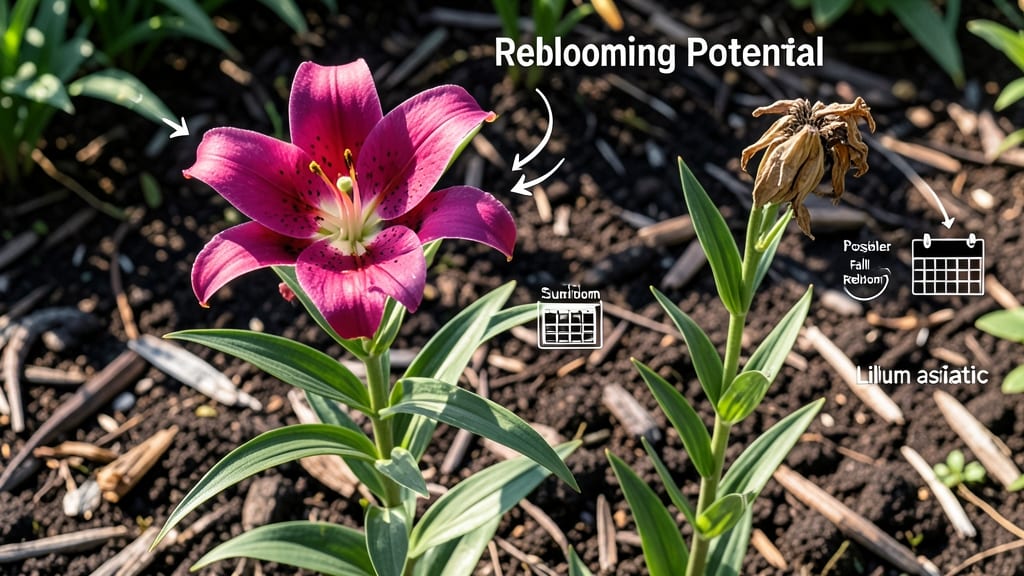
Asiatic lilies generally do not bloom more than once per season, with their showy flowers appearing in late spring or early summer before the plant enters dormancy. While some reblooming Asiatic varieties exist, they demand precise growing conditions to produce a second flush of blooms later in the year.
Most Asiatic lilies follow a one-bloom-per-season pattern because their energy focuses on producing vibrant flowers rather than repeat cycles. 🌸 The plant's natural dormancy period after blooming conserves resources, making it challenging to coax a second round without targeted care.
However, hybrid varieties like 'Stargazer' or 'Casa Blanca' can sometimes rebloom if given the right conditions—think consistent moisture, balanced fertilizer, and partial shade during hot afternoons.
If you're aiming for multiple blooms, start with well-draining soil rich in organic matter and feed them with phosphorus-heavy fertilizer in early spring. After the first bloom, trim spent stems but leave the foliage to photosynthesize and build strength for potential reblooming.
Patience is key—reblooming doesn't happen overnight, but with the right approach, you might just extend your lilies' showtime into early fall.
💡 In This Article
- Why Asiatic Lilies Usually Bloom Only Once
- How to Encourage Reblooming in Asiatic Lilies
Why Asiatic lilies usually bloom only once
Asiatic lilies follow a strict monocarpic blooming pattern—they devote nearly all their energy to producing a single, spectacular flower show in late spring or early summer.
This is because their natural growth cycle prioritizes reproductive energy over extended flowering. 🌸 Unlike perennial flowers that bloom repeatedly, Asiatic lilies store energy in their bulbs during dormancy, which typically lasts from late summer through winter.
The plant’s entire system resets after blooming, making a second flush nearly impossible without intervention.
The key factor is daylight exposure and temperature triggers. Asiatic lilies rely on 12-14 hours of daylight and soil temperatures above 60°F to initiate blooming. Once they flower, the plant’s internal clock shifts toward dormancy, triggered by shortening daylight and cooler temperatures.
This biological mechanism ensures survival in their native Mediterranean climate, where resources are scarce after the growing season. 💫 Compare this to Oriental lilies, which can rebloom because they’ve adapted to store more energy in their bulbs and foliage, allowing for a second bloom cycle under ideal conditions.
Climate plays a huge role in blooming patterns. In regions with hot, dry summers, Asiatic lilies may enter dormancy earlier, cutting short any potential for reblooming. Conversely, in cooler coastal climates with mild summers, some varieties might linger longer—but even then, a second bloom is rare.
The plant’s natural survival strategy prioritizes bulb health over extended flowering, which is why gardeners often see just one burst of color before the foliage yellows and dies back.
What most people don’t realize is that Asiatic lilies require a full dormancy period to rebloom. Skipping this rest phase—by keeping the plant too moist or warm—can exhaust the bulb’s reserves, making it weaker for the next season.
This is why forcing reblooming often backfires: the plant simply doesn’t have the energy to repeat the process. 🔥 For example, a bulb that blooms in June and is then fertilized aggressively in July may produce a few small buds in August, but these will be weak and short-lived, draining the bulb’s strength for the following year.
To put it in perspective, consider how Asiatic lilies compare to their reblooming cousins like Oriental or LA hybrids. These varieties have been selectively bred to store more nutrients in their foliage and bulbs, allowing them to produce a second bloom with proper care.
Asiatic lilies, however, lack this genetic adaptation, making their single-season performance both predictable and, in many ways, more dramatic—one spectacular show rather than a prolonged but less intense display.
Understanding this botanical reality helps gardeners set realistic expectations. While Asiatic lilies may not rebloom naturally, their vibrant, long-lasting flowers (often 7-10 days per bloom) make them a stunning addition to any garden—just once per season.
The trade-off is a plant that thrives on minimal maintenance and delivers a bold, reliable spectacle when conditions are right.